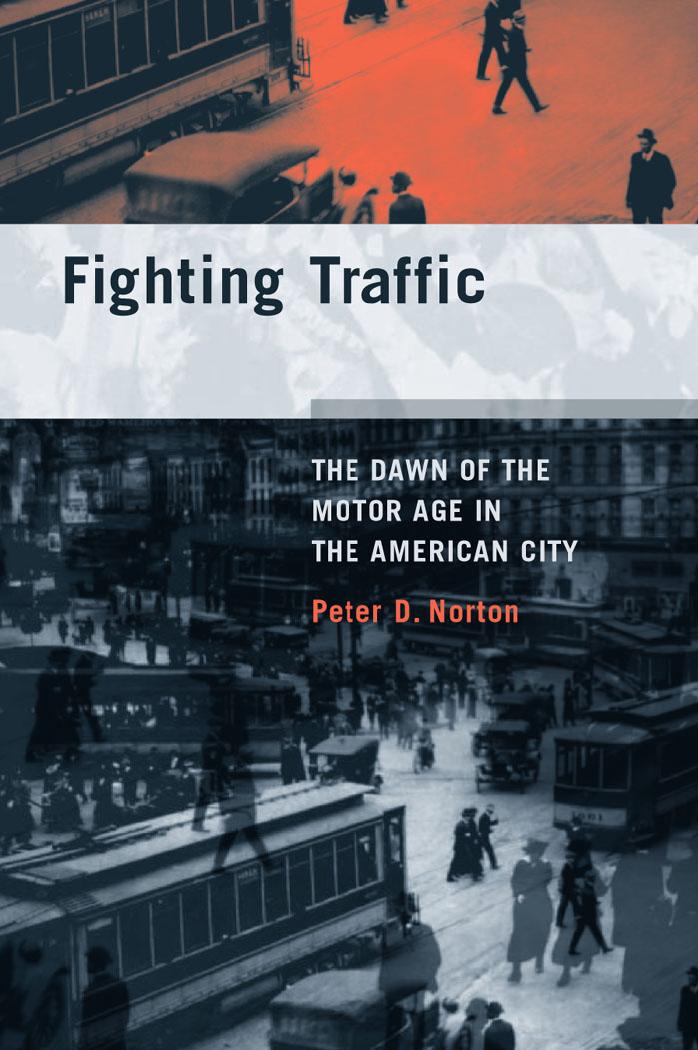
Fighting Traffic: The Dawn of the Motor Age in the American City by Peter D. Norton
Author:Peter D. Norton [Norton, Peter D.]
Language: eng
Format: epub, pdf
Tags: Technology & Engineering, History, social aspects
ISBN: 9780262293884
Google: RxfqJoqhtpUC
Publisher: MIT Press
Published: 2011-01-21T01:03:56.897025+00:00
The Gasoline Tax
For practical reasons, streets have been a public responsibility. Users could not be charged for each use, and the street was the original home of the free-rider problem. Although merchants' associations sometimes improved and even built streets, the main builders were public agencies funded through property assessments, often supplemented by bond issues.
In the 1920s a new kind of charge gave some a reason to hope that users might pay in proportion to their use. Outside city limits, beginning in 1919, gasoline excise taxes allowed roads to function more like other consumer commodities.11° The tax, in theory, reduced the state's role to that of a broker between road purchasers (motorists) and road builders. In fact road location and building remained notoriously political. Nevertheless the gasoline tax promised to subject road supply to economic laws. Politicians would not have to decide how much to spend on roads; users themselves would decide, as an automatic function of their own demand. The more people drove, the more revenue would accrue, and the more roads would be built. At last the market would rule.
Much of the new gasoline tax revenue was spent on county and state highways. These routes were almost exclusively rural in 1920, but as the new highway funds poured in, counties and states began to extend them into and through cities. Beginning in the late 1920s and at an accelerating pace thereafter, counties and states turned to highway engineers to solve city traffic problems. Highway engineers brought highways into the cities, reducing the role of city traffic control engineers in the congestion problem. The new urban thoroughfares were largely bought and paid for by motorists with gasoline tax money.
State and local governments were quick to recognize revenue possibilities in the growing number of motorists. License and registration fees were universal by 1913.11 Motorists and their auto clubs resisted. Through the early 1920s, most auto interests fought for low fees, for the use of general revenues supplemented by federal aid in state highway projects, and for the use of bond issues and special assessments of property holders to pay for city streets and county roads. Auto interests rallied to defeat proposals for a federal gasoline tax in 1914 and 1915.112 They accepted the generally held view that roads and streets were public property, available to all, and on this ground they held that that the burden should be shared by taxpayers in general.
From this perspective, gasoline taxes were merely another way to soak motorists. The tax was proposed first by the backers of good rural roads in the West, including auto clubs representing rural motorists, who saw in it a way to get them. In 1919 Oregon, Colorado, and New Mexico introduced the first state gasoline taxes, and in 1921 the Supreme Court upheld their constitutionality. But except in rural areas automotive interests fought the trend. In 1920 Alfred Reeves, general manager of the National Automobile Chamber of Commerce, told a friendly audience: "As to the tax on gasoline, gentlemen, there
Download
Fighting Traffic: The Dawn of the Motor Age in the American City by Peter D. Norton.pdf
This site does not store any files on its server. We only index and link to content provided by other sites. Please contact the content providers to delete copyright contents if any and email us, we'll remove relevant links or contents immediately.
Whiskies Galore by Ian Buxton(42084)
Introduction to Aircraft Design (Cambridge Aerospace Series) by John P. Fielding(33175)
Small Unmanned Fixed-wing Aircraft Design by Andrew J. Keane Andras Sobester James P. Scanlan & András Sóbester & James P. Scanlan(32835)
Aircraft Design of WWII: A Sketchbook by Lockheed Aircraft Corporation(32333)
Craft Beer for the Homebrewer by Michael Agnew(18287)
Turbulence by E. J. Noyes(8113)
The Complete Stick Figure Physics Tutorials by Allen Sarah(7424)
The Institute by Stephen King(7093)
The Thirst by Nesbo Jo(7005)
Kaplan MCAT General Chemistry Review by Kaplan(6990)
Bad Blood by John Carreyrou(6671)
Modelling of Convective Heat and Mass Transfer in Rotating Flows by Igor V. Shevchuk(6495)
Weapons of Math Destruction by Cathy O'Neil(6365)
Learning SQL by Alan Beaulieu(6345)
Man-made Catastrophes and Risk Information Concealment by Dmitry Chernov & Didier Sornette(6139)
Permanent Record by Edward Snowden(5892)
Digital Minimalism by Cal Newport;(5837)
Life 3.0: Being Human in the Age of Artificial Intelligence by Tegmark Max(5619)
iGen by Jean M. Twenge(5454)
